A Target Is Not a Result: Reading Policy Commitments Carefully
Learn how to read rural policy commitments by separating targets, delivery steps, and observable results, so you can tell what changed and what remains unclear.
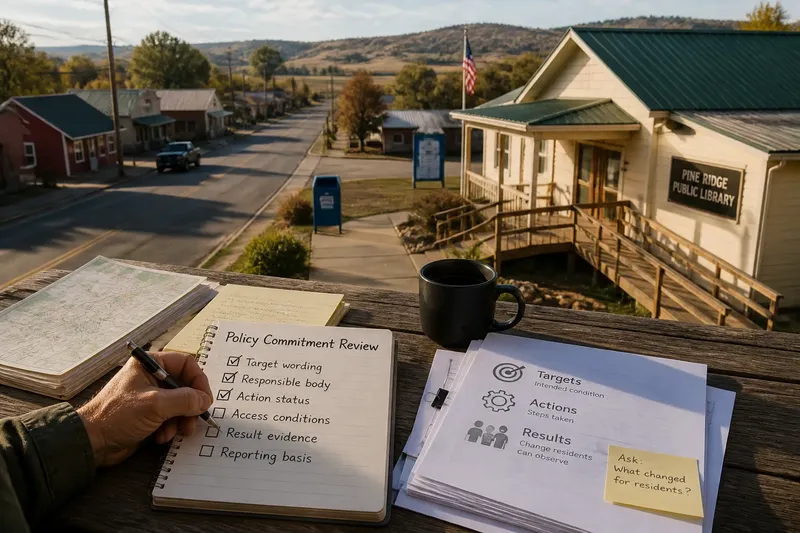
Has a rural policy promise changed anything residents can use, or does it still describe an intention? Reading rural policy commitments means separating the target from the action taken and the result people can observe. A sentence promising to “improve access” does not say which service will change or how residents will notice.
Public updates often put goals, funding decisions, and service reports together. Each can matter, but they answer different questions. Keeping those distinctions clear makes it easier to recognize progress without claiming more than the evidence supports.
Targets, actions, results
A target states an intended condition: who or what a policy aims to affect. “Improve access to county records for residents in remote communities” names a direction, but leaves the intended change open.
An implementation step is work intended to move toward that target. It could include hiring a records clerk, setting up a public computer terminal, or changing how requests are handled. Those actions may be important, but completing them does not establish that residents can use the service more easily.
A result describes a change in access or experience. For example, residents may be able to request records at a local office rather than travel to the county seat. A report about results should make clear whose circumstances changed and how the agency knows.
These claims form a chain, not a set of interchangeable labels. A funded project is a decision; an open service point is a delivery milestone; residents’ ability to use that point is a result to examine.
Read the exact claim
Words such as aims, plans, and will seek usually indicate intent. Words such as hired, opened, or issued point to actions. Phrases such as residents can now request describe a service condition, though the claim still needs a clear basis.
Look for the subject, the action, and the condition. “The county will improve access to records” is a broad aim. “The county plans to accept records requests at the Pine Ridge library” identifies a proposed change, but remains a plan until the service is available. “Residents can submit requests at the library during its public service hours” describes a condition that can be checked.
Then check the scope. Does the promise cover every resident, a defined group, or certain communities? Does it concern availability, ease of use, response, or the final outcome? A policy may make a narrow improvement while leaving other needs untouched. That can be a reasonable choice, but its limits should be stated plainly.
Match evidence to claims
If an update says a policy is “on track,” ask what that means. The phrase might refer to funding, staffing, a signed agreement, or a service already in operation. Those details can show progress in delivery; they do not necessarily show that residents’ access has changed.
For a local records service, different sources answer different questions. A council agenda may show that officials approved a service point. A public notice can identify its location and hours. Request instructions can explain who may use it and how. None of these alone shows whether the process works for the people the policy names.
Notice what is missing. A room may be open but lack staff who can explain the process. A public computer may be available, but the request form could require information residents cannot readily obtain. If the promise concerns access, evidence about the room or equipment alone may not settle the question.
An output is something delivered directly, such as requests accepted or office hours offered. An outcome is a change in people’s circumstances, such as being able to submit a request locally. Outputs help explain what a service does; outcomes address whether the underlying condition changed.
Questions about commitments?
Does meeting a target mean the policy worked?
It means the agency reports meeting the target as it defined it. Whether residents experienced a meaningful change depends on the target’s scope and evidence about the service.
Can delivery count as progress?
Yes. Opening a service point or changing a process can be real progress. Describe the action accurately, without presenting it as proof of a broader result.
What should I do if a target changes?
Keep the original wording and note the revised target and the reason given. Ask what evidence will be used to assess the revised commitment.
Where can I check a reported result?
Start with the public body responsible for the service and look for meeting records, public notices, operating instructions, or reports. If the basis for a claim is unclear, ask what the agency counts and where residents can review that information.
Track the next update
A brief record can help you compare an announcement with later reports. Use the same questions each time, and make a decision based on what the document actually says.
- Target wording: Check whether the announcement names a service, population, and intended change. If it does, preserve that wording for comparison; if it does not, record what is missing and ask the responsible office to clarify the scope.
- Responsible body: Check which agency or department owns the commitment. If one is named, direct follow-up there; if responsibility is unclear, ask the issuing office who will report on delivery.
- Action status: Check whether funding, staffing, or a service change is described as planned or completed. If completed, record it as a delivery step; if planned, treat it as an intention until a later update confirms the action.
- Access conditions: Check the location, hours, eligibility, and request method. If these are stated, compare them with the target group’s needs; if they are absent, ask which residents can use the service and how.
- Result evidence: Check whether the report describes residents’ access or only agency activity. If it describes a visible change, note who is included; if it lists only outputs, avoid treating those counts as proof of an outcome.
- Reporting basis: Check how the agency supports a claim such as “access improved.” If it identifies records or a clear measure, note what that evidence covers; if not, ask what information supports the statement and where it can be reviewed.
It is not worth tracking every press release or assembling a scorecard from unrelated fragments. Follow the policy’s stated reporting points, save the original wording, and ask a focused question when an update blurs an action with a result.
A worked reading
Imagine a county announces that it will make property records easier to request in three remote communities. The announcement names the goal but no service change. You record it as a target and ask whether the county means local request locations, simpler forms, or another change.
In a later update, the county says it has arranged for requests to be accepted at two library branches. You mark that as a delivery action, then check the public notice for branch locations, hours, eligibility, and instructions. Suppose the notice confirms that residents may submit requests there, but says nothing about the third community. Your reading is now specific: a local request option is available at two branches, while the stated coverage of the third community remains unclear. You can ask the county whether it plans another access point or considers the existing arrangement sufficient.
This example does not establish whether the policy succeeds. It shows how to state what the announcement, action, and service information each support—and where a useful question remains.
Keep claims proportionate
Rural services can reach communities unevenly. A service may be available in one place but harder to use elsewhere, especially when local support or a convenient way to submit a request is absent. Reports should make those boundaries visible rather than turn a partial change into a sweeping claim.
When reading rural policy commitments, ask what is intended, what action has occurred, and what residents can now do that they could not do before. That last question keeps the main search phrase—reading rural policy commitments—tied to a practical test: describe the change precisely, and leave room for what the evidence has not yet answered.