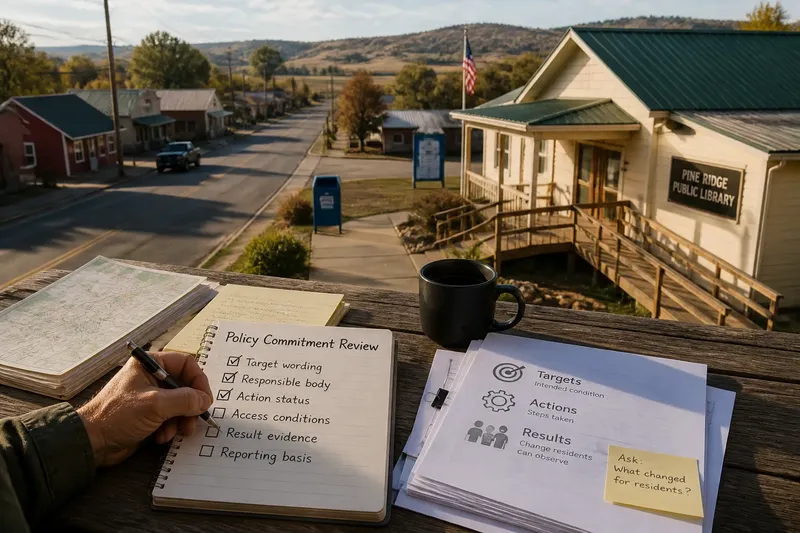
From Public Goal to Policy Aim: What Changes When a Problem Is Defined
Learn how defining a rural public problem shapes a policy aim, clarifies what government can influence, and keeps distinct local needs in view.

Who is a rural policy aim meant to serve, and what condition should change? A definition of the problem answers both questions before a program is designed. For example, a public concern about keeping a small-town post office accessible could be framed around distance, limited service hours, or residents’ difficulty completing essential transactions. Each framing points to a different aim.
Defining policy aims
A policy aim names the public condition government intends to improve. It is broader than an activity and more focused than a general aspiration. “Maintain access to essential postal services” is an aim; keeping a particular branch open on specified hours is one possible action.
The distinction matters because an aim can guide decisions even when the program or funding arrangement changes. Elected officials, agencies, and residents can use it to ask whether proposed actions address the same public concern. A clear aim also leaves room to adapt how services are delivered in places with different needs.
“Support thriving rural communities” may express a genuine priority, but it does not identify a condition to change. “Keep essential postal services reachable for residents without reliable alternatives” is more precise without assuming that every community needs the same service design.
Problem definitions
A definition selects which parts of a situation count as the public problem. It may emphasize a cause, an affected group, a service gap, or a consequence. The aim tends to reflect that emphasis.
Consider a community concerned about the loss of a local post office. If officials define the problem as a lack of nearby facilities, an aim might focus on keeping services physically accessible. If they define it as difficulty completing essential transactions, the aim might focus on access to those transactions, including options beyond a branch. These aims overlap, but they describe different conditions.
Definitions also set boundaries around what public institutions can influence. A local government may be able to support a shared service counter or provide information about alternatives. It may have little authority over a federal agency’s decisions about branch operations. An aim that ignores those limits can blur the difference between a public priority and a promise beyond the responsible institution’s control.
Whose needs count
The people named in a problem definition shape whose experience is visible. A description centered on residents who live far from a service may miss people who cannot drive, need accessible facilities, lack reliable internet, or depend on in-person help with forms.
Residents, tribal governments, local organizations, service providers, and public officials can each see a different part of the same problem. Their accounts may conflict, but listening can surface assumptions that an administrative description leaves out. The point is not to treat any single account as complete; it is to make the differences visible before setting the aim.
Say a county begins with the phrase “limited access to postal services.” Residents explain that a shared counter is nearby but cannot handle certain transactions, while the nearest full-service branch is difficult to reach. Officials could revise the problem definition to distinguish basic transactions from services that require a full branch. The resulting aim would identify which access gap public action is intended to address, rather than treating every location as equally served.
Testing a public aim
A sound aim links a defined condition to something public action can plausibly influence. It should guide choices without confusing the desired outcome with a preferred tool. Use these checks to decide whether the wording is ready for public discussion:
- Check the condition named. If the aim says only “rural disadvantage,” identify a specific difficulty before proceeding; if it names a condition residents can recognize, keep that wording in view.
- Check who is included. If the definition covers only people living far from a service, add other affected groups if local accounts identify them; if it reflects the relevant differences, retain the scope and state it plainly.
- Check public authority. If the responsible agency cannot influence the named condition, narrow the aim to the part it can affect or identify which other institution must act; if authority is clear, preserve that connection.
- Check local variation. If identical delivery would leave some settlements poorly served, describe a shared purpose that allows different local arrangements; if the same approach fits the needs identified, explain why uniform delivery is appropriate.
- Check whether change can be recognized. If readers cannot tell what would look different for residents, revise the condition; if they can describe the intended change, keep it distinct from later choices about indicators.
- Check whether the wording embeds a tool. If the aim names a favored program rather than a public condition, rewrite it around the condition; if it states the condition independently, compare tools later.
These checks cannot settle every disagreement. They can show whether a sentence functions as a public aim, a slogan, a proposed tool, or an outcome outside the expected reach of the institutions involved.
Competing priorities
Defining a problem often reveals competing needs. Preserving a local facility may matter to residents who rely on in-person help, while concentrating services may make it easier to maintain specialized support. An aim should make the chosen priority and its limits understandable instead of hiding a trade-off in technical language.
Competing methods are not always competing aims. A shared aim such as “maintain access to essential services” might be pursued through a local counter, mobile service, or agreements with neighboring communities. Each option addresses different needs, and none should be treated as a complete answer without considering who may still be left out.
It is not worth spending time polishing a sentence while its definition excludes people affected by the problem. Elegant wording cannot fix a narrow account of whose needs count.
Reading public aims
When you read a policy aim, ask what condition is expected to change, for whom, and what remains outside the policy’s reach. Then look for a clear link between that condition and the proposed actions.
If a policy document describes a rural problem differently from residents, the difference calls for explanation, not an automatic verdict. It may reflect a limit on public authority, a deliberate priority, or a definition that needs reconsideration. Ask which explanation applies and how the final aim accounts for the people affected.
Questions about policy aims?
Is a policy aim the same as a policy goal?
Organizations may use the terms differently. In general, a goal signals a broad public direction, while an aim names a condition policy intends to improve.
Can one rural problem have several definitions?
Yes. A service concern might involve distance, accessibility, cost, hours, or the range of transactions available. Each definition can identify a real part of the problem while pointing toward a different aim.
Should residents help define a public problem?
Resident input can reveal barriers missing from administrative descriptions. Decision-makers should explain how they considered that input and why the final definition emphasizes particular concerns.
Can an aim change after a policy begins?
Yes, if experience reveals that the original definition missed an important condition or local circumstances change. Explain whether the public priority changed or whether officials revised their understanding of the problem.
The phrase “public goal to policy aim” describes a narrowing: a broad concern becomes a condition public institutions can try to influence. For rural policy, a useful aim keeps distinct local needs visible while stating honestly what government can shape. That clarity gives residents a better basis for judging whether an eventual action fits the problem it claims to address.