The Policy Cycle: From Proposal to Review
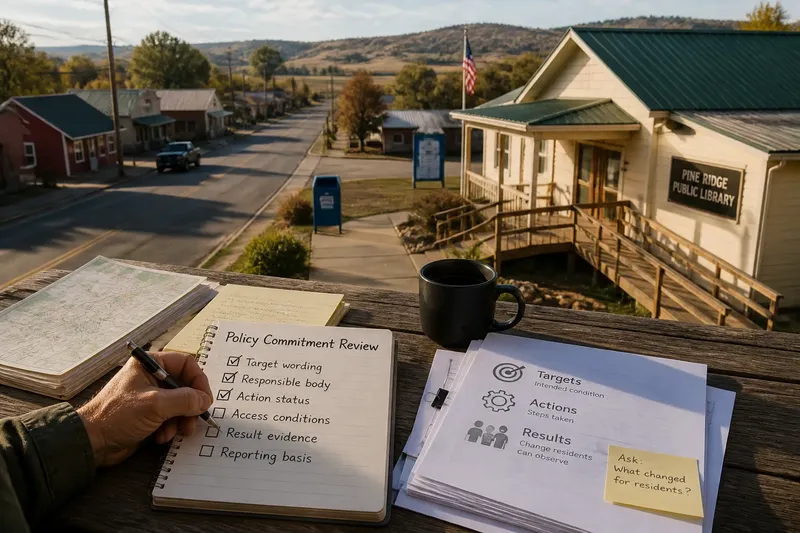
The policy cycle shows how a rural service moves from local concern to review, helping readers trace responsibility, spot delivery gaps, and see what may change.

How does a rural policy idea become a service people can actually use, and what happens when the first plan falls short? The policy cycle traces that path from proposal to review, but it is better understood as a series of decisions than as a tidy loop. Imagine a fictional county whose residents struggle to reach a public library branch after its hours change. The county considers extending access through a shared-use agreement with a nearby school. Following that idea through each stage shows where public purposes become practical arrangements, and why review can send policy back for revision.
Policy cycle concerns
The first stage is recognizing a problem that public action might address. Residents may describe the issue as a longer trip to borrow books, fewer places to use public computers, or difficulty finding a quiet place to study. Those accounts matter, but they do not yet specify what government should do. Officials need to understand how the difficulty differs across the county and which public responsibilities apply.
In this invented case, the county library board gathers comments at branch meetings and asks librarians about changes in visitor needs. Staff also review the branch schedule, nearby public facilities, and the school’s rules for community use. The purpose is not to prove that a shared-use agreement is the answer. It is to make the reported difficulty concrete enough to consider possible responses.
How the concern is framed affects what comes next. If officials treat it only as a lack of open buildings, they may overlook transportation or schedule barriers. If they treat it only as a transportation problem, they may miss the role of reliable internet access or a suitable study space. A useful early account keeps these possibilities visible without turning a preliminary explanation into a settled conclusion.
Options enter the proposal
Once officials have a clearer account of the concern, they can develop a proposal. That means comparing plausible approaches, identifying who would be responsible, and making the intended public purpose explicit. Options might include adjusting library hours, coordinating with another public facility, supporting a mobile library, or arranging access to a school library after classes. Each would organize public effort differently.
In the fictional county, staff outline two options: open the branch for an additional evening using existing staff, or negotiate shared access to the school library. The first may be easier to explain but depend on staff availability. The second may reach residents in a different part of the county but require agreement on supervision, access, and building security. These are considerations in the invented situation, not claims about actual programs.
A proposal also needs a workable account of authority and resources. Staff identify which county office could manage the arrangement, what funding might be available, and whether the school district would provide staff or building access. They describe what the service is meant to change, such as making a dependable place for reading and study easier to reach. This gives decision-makers something more useful than broad support: a choice with responsibilities and foreseeable trade-offs.
Public input can alter the proposal before it becomes a formal decision. In the imagined county, residents say that a school site would be useful only if community visitors could enter without passing through restricted areas. Officials revise the draft to describe a separate entrance and a sign-in process, while noting that the district must approve those arrangements. Consultation does not mean every request can be met. It can reveal which details would make a proposed service usable for the people it is intended to serve.
Authorization sets terms
A proposal becomes policy only through an authorized decision. Depending on the issue and jurisdiction, that might involve a council vote, an agency decision, a budget approval, or a formal agreement with a service partner. This stage establishes permission and direction; it does not itself open a building to the public.
In the invented case, the county board approves a limited shared-use arrangement and asks the library director to report back on access and operating difficulties. The approval sets a purpose and an oversight expectation. It also leaves questions for implementation: who may enter, which rooms are available, how visitors learn the schedule, and whom staff contact if an event conflicts with access.
Authorization may narrow the original proposal. The board could approve use of the school site but not added library hours, or ask staff to return with a fuller agreement before public access begins. Those changes are not necessarily evidence that the policy has failed. They show that public choices take place within budget, legal, and administrative limits. A clear record of what was approved helps residents distinguish the adopted policy from options discussed but not selected.
Delivery makes policy tangible
Implementation is where an approved decision becomes a routine that people encounter. The responsible office must assign tasks, arrange partnerships, communicate eligibility, and connect the service to the places and institutions it is meant to support. A policy can be well intentioned yet hard to use if those working arrangements are unclear.
For the fictional arrangement, library staff coordinate with the school district, while librarians explain how residents can use the shared space. The county prepares a public notice and tells community groups where to direct questions. School staff need clear guidance about entry, room access, and whom to contact when a school event changes the plan. These details are part of policy delivery because they shape whether the approved service can be reached in ordinary circumstances.
Implementation also brings new information. Suppose, in this invented situation, residents arrive at the school but are unsure which entrance to use. The county can clarify its notice and ask the school to post the same directions at the site. That adjustment does not alter the policy’s broad purpose, but it changes the service people experience. Other problems may require a larger decision: a partner may lack staff capacity, a facility may be unavailable during the planned hours, or the sign-in process may be difficult for some visitors.
For that reason, delivery is not merely the final administrative task after policy has been made. It can expose assumptions that were invisible in a meeting room. Frontline staff, service partners, and residents see different parts of the arrangement. A useful implementation process gives them a way to flag obstacles while the policy is operating, rather than treating every difficulty as an individual exception.
Review asks what changed
Review considers whether the policy is being delivered as intended and what can reasonably be learned from its operation. It asks more than whether an activity occurred. In the fictional county, officials might examine whether residents understand how to enter, whether the shared space is available as planned, which communities remain difficult to reach, and what obstacles staff report. Those questions help separate operational issues from questions about the original design.
Imagine the county’s review finds that residents can use the school space, but some planned openings are canceled when school activities take priority. This is an invented result, not a real finding. It illustrates why review should compare the policy’s stated purpose with observable delivery, while also recording what the available information cannot establish.
A review can lead to several responses. Officials might revise the schedule, clarify the agreement, continue the arrangement while gathering more information, or propose a different approach for the board to consider. They might also decide that a stated aim needs clearer definition. Each response involves a choice about what the available information can support and which public constraints remain. Local rules, formal authority, and the terms of any funding or service agreement determine which changes require further approval.
When does the cycle turn?
Is the policy cycle always linear?
No. A proposal can be revised during consultation, and delivery problems can send officials back to reconsider the design. The stages help locate decisions; they do not claim public work proceeds in a single direction.
Who carries out implementation?
Responsibility may sit with a public agency, a local government office, a contractor, a nonprofit partner, or several of them together. The adopted policy and its agreements should make clear who handles delivery and who oversees it.
What should a review examine?
A review should consider both whether the service was delivered and whether its arrangement addressed the stated concern. It should also note missing information, uneven access, and feedback that could change the next decision.
Does review end the policy cycle?
Not necessarily. Officials may adjust delivery, seek new authorization, continue the existing approach, or stop it, depending on the review and the public decisions that follow. The cycle continues when those choices lead to another round of design and action.
Decisions across stages
The fictional shared-use proposal shows why the stages matter without making them a formula. Naming a concern is different from selecting a response. Approving a response is different from arranging its daily operation. Reviewing the operation is different from declaring success or failure. Each stage asks for a different kind of judgment and makes different information available.
It is not worth the effort to force every local decision into a perfect cycle diagram or to treat each stage as a paperwork gate. A diagram cannot capture every negotiation, delay, or informal adjustment. The more useful question is what decision is being made now, who has authority to make it, and what information should shape the next one.
When reading a rural service proposal, the policy cycle offers a practical way to follow responsibility from public concern to review. Look for the handoffs: who defined the issue, who selected the response, who must deliver it, and who will revisit its effects. In the imagined county, shared access becomes more than an announcement only when those connections are clear—and review matters because it gives the next decision a firmer starting point.